How Our Cigarette Packaging Paper Manufacturer Team Controls Every Order
A packaging programme becomes difficult when artwork, paper, finishing and delivery are managed as separate conversations. One team approves colour, another changes the substrate, and production receives an outdated file.
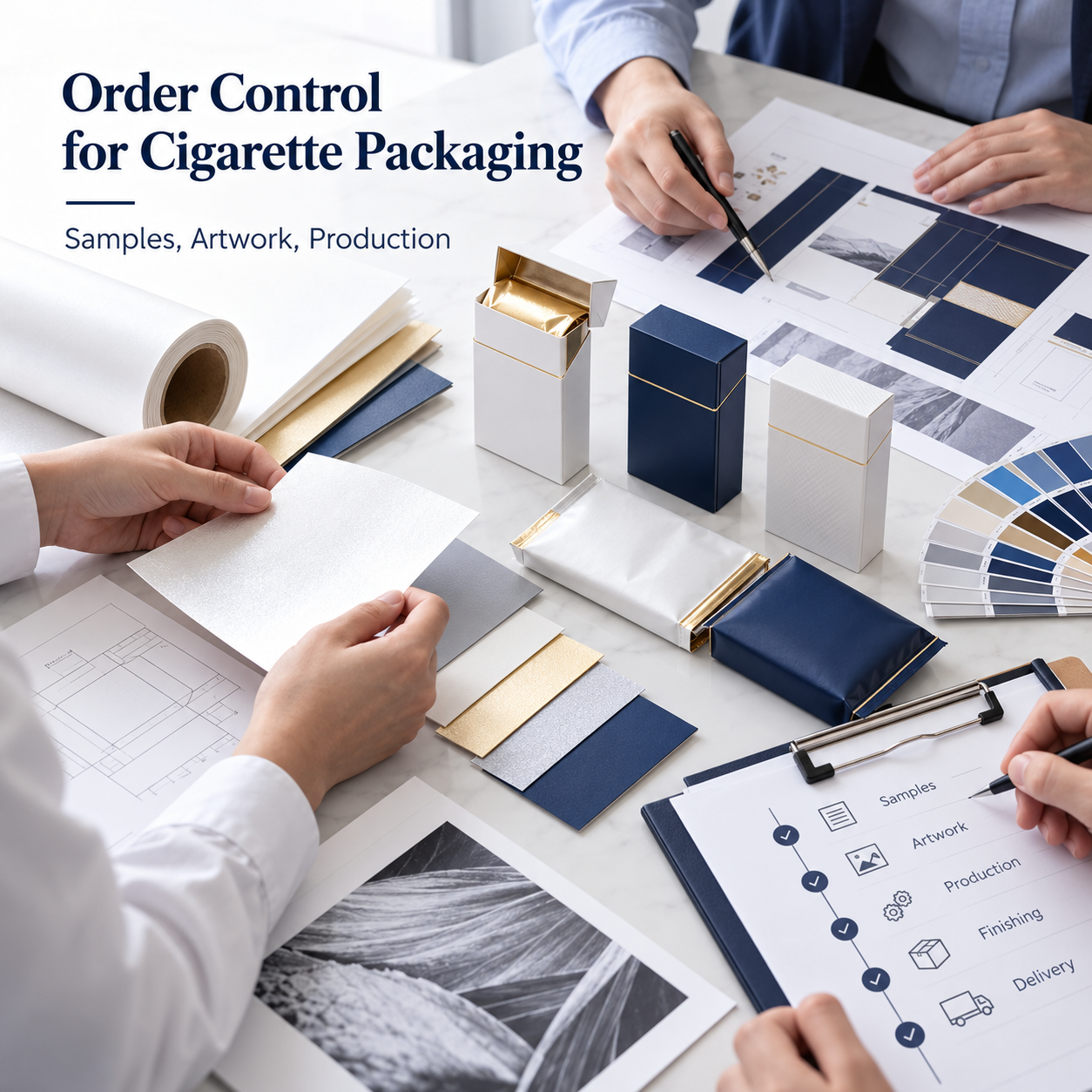
A packaging programme becomes difficult when artwork, paper, finishing and delivery are managed as separate conversations. One team approves colour, another changes the substrate, and production receives an outdated file. We built our working method to close those gaps. As a Cigarette Packaging Paper Manufacturer, Zhejiang Muchen Intelligent Technology Co., Ltd. connects specification review, sample approval, printing, converting and repeat-order control in one project path.
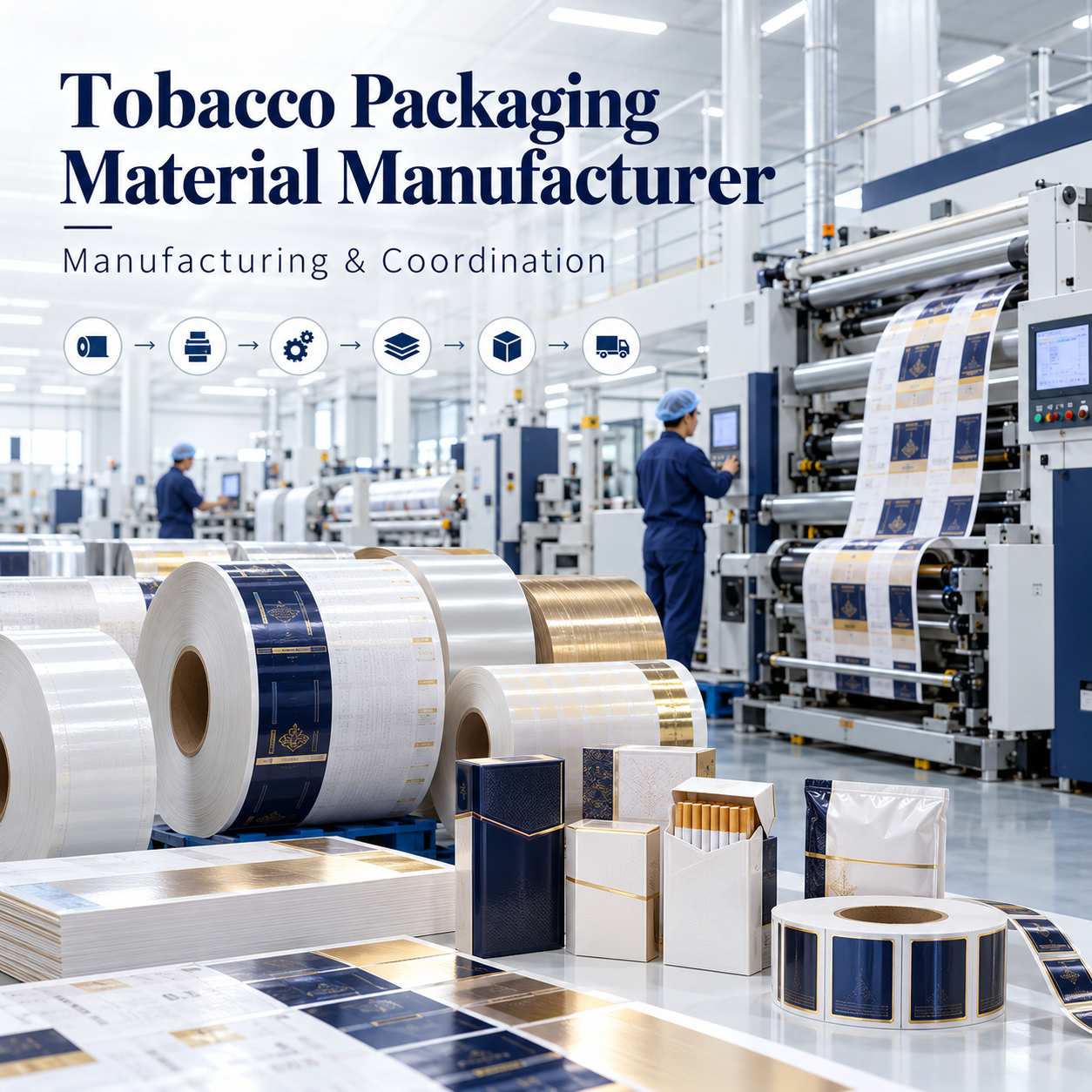
Our 5,500 m² Deqing facility contains five specialised workshops. The product portfolio covers cigarette inner liner paper, hard-pack packaging, soft-pack packaging, paper and film self-adhesive labels, and a range of art papers. For tobacco packaging buyers, the most useful part of that breadth is the ability to discuss the pack, printed surface, finishing and identification requirements together before production starts.
Table of Contents
1. Our Work Starts with the Finished Pack
2. How Five Workshops Support One Specification
3. Our Project Stages Compared
4. Colour and Artwork Control in Daily Production
5. A 2025 Printing Technology Milestone
6. What Buyers Receive Before Repeat Orders
7. Frequently Asked Questions
8. Discuss Your Next Tobacco Packaging Programme
Our Work Starts with the Finished Pack
We begin with the pack that the customer needs to run and sell, not with a machine list. For inner liner paper, we ask about the bundle, barrier expectation, embossing or print, reel direction and wrapping behaviour. For hard packs, we review board response, panel layout, creasing and decorative finish. For soft packs, web handling, flexibility, cutting and seam position become more important. This keeps the material decision tied to the real converting task.
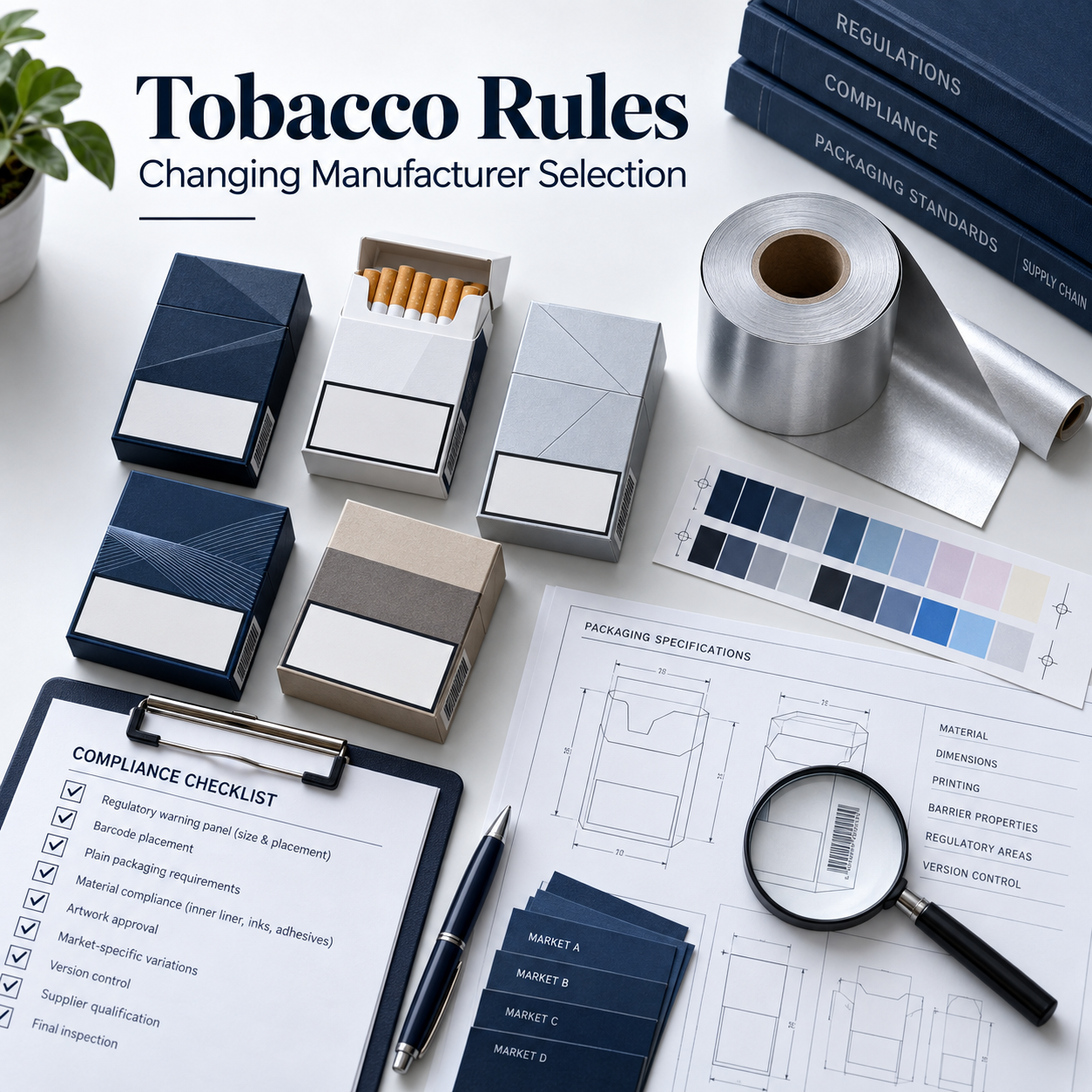
The customer’s destination market is another early input. Health warnings, languages, barcodes, tax features and brand restrictions affect artwork control. We do not create the customer’s legal requirements; we manufacture from the approved files and specifications. Our job is to make sure those files are translated into clear production references, with the correct version connected to the correct material and order.
Commercial information is also technical information. Expected volume influences material planning, tooling decisions and production scheduling. Shipment format affects moisture protection, pallet design and labels. Our current enquiry terms list a 10-tonne MOQ, approximately 15 days for samples and 30 to 45 days for production. We confirm the final plan after reviewing construction, printing, finishing, approval status and quantity.
How Five Workshops Support One Specification
Our Deqing manufacturing site covers 5,500 square metres and includes five specialised workshops plus dedicated production capability. Separating operations can improve control, but only if every area works from the same specification. We use the approved job information to connect substrate, artwork, printing route, finishing, conversion, inspection and packing. A change at one stage is reviewed for its effect on the others.
The equipment portfolio includes a Muwei 10-colour flexo roll-to-roll press, a Taiwan Luocai 6+1 rotary transfer label printer, a Labelking UV flexo line with inline finishing and a Japan Rinto six-colour no-ink label press. Proprietary laser-engraved printing plates and silkscreen, inkjet and die-cutting units support additional routes. We select the process around the required material and finish rather than presenting one machine as suitable for every job.
This matters for cigarette packaging because surfaces behave differently. Aluminium-foil composite liner paper reflects light and changes colour perception. Coated hard-pack material must survive creasing. Flexible soft-pack material needs stable web control. A process that produces attractive colour but damages fold performance is not a successful process. We therefore review visual quality and converting behaviour together.
Our Project Stages Compared
Project stage | Our main work | Customer decision | Controlled result |
Specification review | Align pack, material, artwork, finish and machine needs | Confirm fixed requirements and open options | Technical review list |
Prepress and sampling | Prepare print route and representative sample | Approve appearance and version | Signed sample and file revision |
Line qualification | Check converting and packing behaviour | Approve trial performance | Released production condition |
Volume production | Control materials, printing, conversion and inspection | Confirm shipment plan | Traceable finished lot |
Repeat order | Review forecast, changes and retained references | Approve any new revision | Consistent reorder basis |
Each stage has a different purpose. A beautiful sample does not prove line performance, and a successful line trial does not authorise an unapproved artwork change. Keeping these decisions separate makes the approval record more useful. It also tells both teams what is still open before money is committed to material, plates, finishing or volume production.
We keep samples and documents linked by job and revision. The reference should show what the customer approved, which construction was used and what finishing route produced it. If a later order changes colour, dimensions, warning content or pack material, the new requirement becomes a new controlled version instead of an informal instruction written over the old one.
Colour and Artwork Control in Daily Production
Small tobacco packs expose minor print variation. Fine lines, small text, warning borders, metallic backgrounds and tight panel registration leave little room for drift. Before printing, we check file dimensions, separations, orientation, bleed and finishing positions. Spot colours need a physical or measured reference. Process colours need the correct substrate profile and an agreed expectation for how the surface affects appearance.
On press, the first approved result becomes the production reference. Operators monitor colour, registration, print defects and web condition. Converting teams then protect the same reference through cutting, creasing, embossing, winding or stacking. Line clearance and labelled work-in-process prevent different versions from mixing. Final inspection checks the characteristics that matter to the purchase specification rather than relying on a vague ‘looks good’ decision.
Colour communication improves when customers tell us what is important. A corporate spot colour may need a tighter tolerance than a background tint. A metallic effect may be approved visually under defined lighting because instrument readings alone do not describe reflectance. Barcodes and mandatory text require functional readability. By ranking these features, the inspection plan can focus effort where variation creates real risk.
A 2025 Printing Technology Milestone
In November 2025, China’s State Intellectual Property Office granted our invention patent No. ZL 2024 1 0337516.9 for a proprietary letterpress printing apparatus. The patent sits within a portfolio of more than 20 granted patents across printing equipment, label structures and packaging materials. For customers, the useful point is not the certificate alone; it is the continuing investment in process control and practical printing development.
Earlier in 2025, we commissioned a new Labelking UV flexographic printing line with inline finishing. The line strengthens our self-adhesive label capability and broadens inline finishing options. Although label production and cigarette packaging are not identical, the same operating habits matter across both: controlled files, stable colour, accurate registration, clean conversion and traceable release.
These milestones support a broader manufacturing direction built from printing and packaging experience since 2000. We use new equipment and proprietary technology to solve defined production requirements, not to add unsupported claims to a quotation. A project still begins with the customer’s material, artwork, finishing, quality and delivery needs, followed by samples and evidence.
What Buyers Receive Before Repeat Orders
Before repeat production, both sides need a practical release package. It should include the approved construction, artwork revision, colour references, dimensions, finishing positions, winding or stacking format, inspection points and packing method. When applicable, the package also records the representative machine trial and the conditions that produced an acceptable result. This prevents the next order from starting as a new interpretation.
· An approved physical sample linked to the current artwork revision.
· Confirmed material construction, dimensions and converting direction.
· Colour and appearance references suitable for production inspection.
· Defined pack-machine or converting trial results where required.
· Carton, pallet, moisture protection and shipment identification rules.
· Written notification and approval steps for material or process changes.
Repeatability also depends on customer communication. Forecast changes, artwork updates and destination-market changes should arrive before production planning is frozen. In return, we communicate open technical points, sample status and production timing. Clear communication may feel less dramatic than a last-minute rescue, but it is what keeps global packaging programmes stable.
Frequently Asked Questions
Which tobacco packaging products do we manufacture?
Our confirmed tobacco packaging range includes cigarette inner liner paper, hard-pack packaging and soft-pack packaging. We review dimensions, printing, finish, pack format and production requirements before confirming the recommended route.
Can we print complex multi-colour cigarette packaging?
Printing is available in up to 10 colours. Feasibility depends on substrate, artwork, colour sequence, finishing, tolerances and quantity. We evaluate the complete job and prepare a sample approval plan before volume production.
How do we manage confidential artwork?
Customers should identify authorised contacts and confidentiality requirements before file transfer. We then connect access, naming, revision and release responsibilities to the project so only the approved file reaches production.
Can we support OEM and ODM packaging projects?
Yes. Our site lists OEM and ODM support. The practical scope can include material, size, printing and finishing development, while regulatory claims, trademarks and mandatory market content remain subject to customer approval.
Discuss Your Next Tobacco Packaging Programme
A dependable Cigarette Packaging Paper Manufacturer should make the path from specification to repeat order easy to understand. Zhejiang Muchen Intelligent Technology Co., Ltd. combines tobacco packaging products, multi-process printing capability and controlled sample approval at our Deqing facility. Send us your pack samples, drawings, artwork versions, destination markets and forecast so our team can prepare a focused material and production review for your next programme.