Application of Ten-Color Flexographic Printing Technology in Tobacco Packaging: Process Balance of Color Restoration Accuracy and High-Speed Production
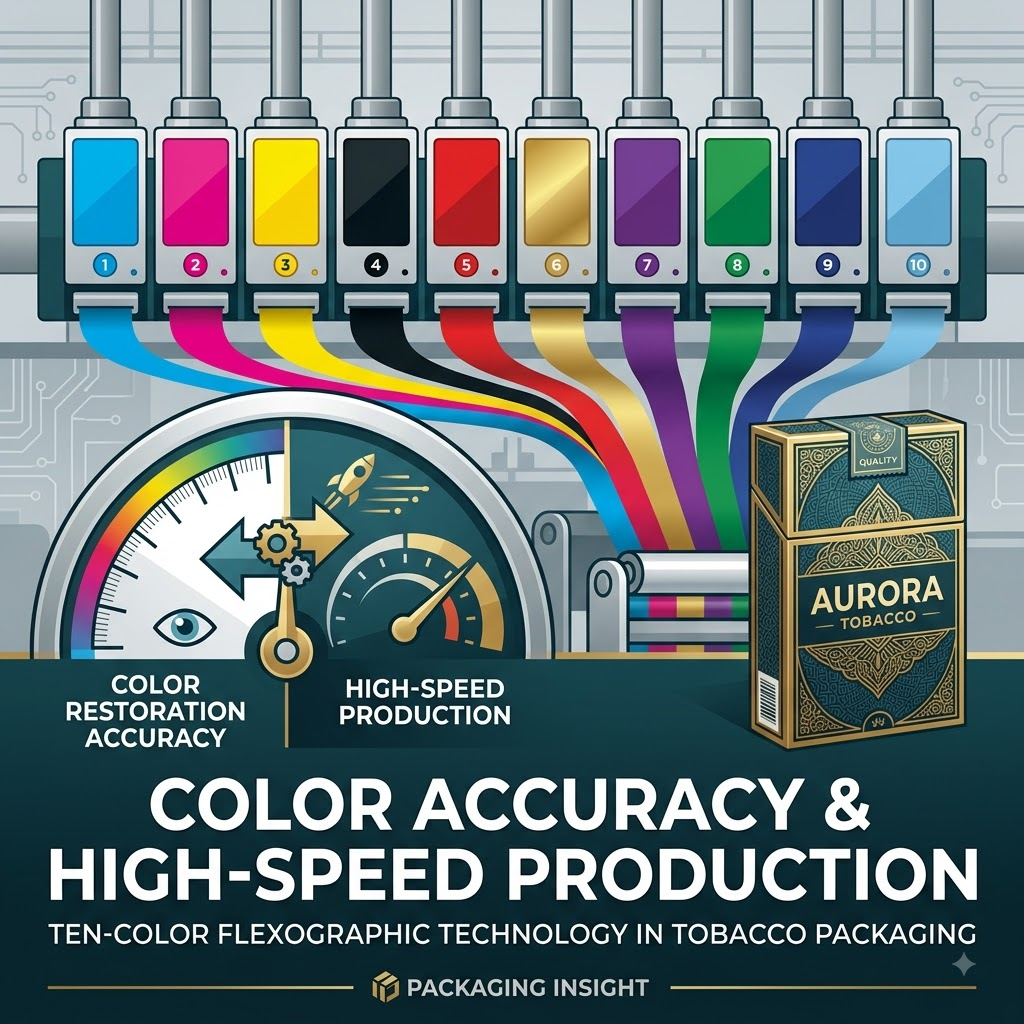
Table of Contents
1. Overview of Ten-Color Flexographic Printing for Tobacco Packaging
2. Core Advantages of Flexographic Printing Technology in Tobacco Packaging Printing
3. Key Factors Affecting Cigarette Box Color Restoration
4. High-Speed Printing Process Parameter Optimization
5. Process Performance Data Comparison: Ten-Color Flexo vs Traditional Printing
6. Practical Process Balance Strategies for Mass Production
7. Industry FAQs
1. Overview of Ten-Color Flexographic Printing for Tobacco Packaging
Tobacco packaging printing has extremely strict requirements for color consistency, layer detail and batch stability. It is different from ordinary food and daily chemical packaging printing standards.
Ten-color flexographic printing is an upgraded iteration of traditional multi-color flexo processes. It can complete ten-layer color overlay and fine pattern printing in a single paper pass.
This advanced flexographic printing technology has gradually replaced part of traditional gravure printing in the tobacco packaging industry. It balances high-precision presentation and green low-consumption production.
Many tobacco packaging manufacturers now prefer ten-color flexo solutions. It solves the long-standing contradiction between high-precision cigarette box color restoration and low production efficiency.
2. Core Advantages of Flexographic Printing Technology in Tobacco Packaging Printing
2.1 Rich Color Layer Presentation
Tobacco package designs usually contain gradient colors, fine lines and subtle texture layers. Ordinary 6-8 color printing cannot restore full design details.
Ten-color flexographic printing expands the color gamut coverage. It effectively improves the layering and three-dimensional sense of high-end cigarette packaging.
2.2 Stable Environmental Protection Performance
Flexographic printing technology uses water-based ink as the main material. It features low VOC emissions and meets global tobacco packaging environmental compliance standards.
Compared with solvent-based gravure printing, it reduces packaging residual odor. This is a key advantage for high-standard tobacco packaging printing scenarios.
2.3 Adaptability for Mass Production
The integrated structural design of ten-color flexo equipment supports continuous roll-to-roll printing. It avoids frequent color registration adjustments in traditional processes.
This feature lays a solid foundation for stable operation of high-speed printing process in large-batch tobacco packaging production.
3. Key Factors Affecting Cigarette Box Color Restoration
Cigarette box color restoration is the core quality index of tobacco packaging printing. Tiny color deviation will lead to inconsistent batch products and affect brand presentation.
In actual production, many factors will interfere with color accuracy. The main influencing factors include ink viscosity, printing pressure and plate dot status.
Unoptimized flexo processes usually cause dot enlargement and color distortion. The average color difference ΔE value may exceed 3.5, which cannot meet tobacco industry standards.
Professional ten-color flexo production can control the color difference stably within ΔE ≤ 1.2. It achieves ultra-high consistency of batch color restoration.
4. High-Speed Printing Process Parameter Optimization
4.1 Printing Speed Matching
Blindly pursuing high speed will damage printing accuracy. Excessively fast running speed causes unstable ink transfer and color registration deviation.
The optimized high-speed printing process for ten-color flexo tobacco packaging sets the stable production speed at 300–350 meters per minute.
4.2 Color Registration & Pressure Calibration
Precision pressure adjustment is critical for multi-color overlay. Uniform printing pressure ensures consistent ink film thickness for each color group.
Advanced ten-color flexo equipment realizes ±0.05mm color registration accuracy. It completely avoids color ghosting and layer misalignment defects.
4.3 Ink & Plate Parameter Control
Adopting flat-top dot flexographic plates can improve ink transfer uniformity. It effectively reduces dot loss in high-speed operation.
Real-time ink viscosity monitoring avoids color floating problems caused by ink dilution changes during long-term production.
5. Process Performance Data Comparison: Ten-Color Flexo vs Traditional Printing
The following data comparison table intuitively shows the performance gap between ten-color flexographic printing and traditional multi-color printing in tobacco packaging production.
Performance Index | Traditional 6-8 Color Flexo Printing | Ten-Color Flexographic Printing | Optimization Effect |
Average Color Difference (ΔE) | 3.2–3.8 | 1.0–1.2 | Color accuracy improved 68% |
Stable Printing Speed (m/min) | 180–220 | 300–350 | Production efficiency improved 62% |
Batch Qualified Rate | 85.2% | 98.1% | Pass rate increased 12.9% |
Dot Restoration Rate | 82–85% | 94–96% | Dot detail improved significantly |
Data verification shows that ten-color flexographic printing technology achieves a perfect balance between high-precision cigarette box color restoration and high-speed continuous production.
6. Practical Process Balance Strategies for Mass Production
Many manufacturers face a dilemma: high precision will reduce speed, and high speed will sacrifice color quality. Reasonable process tuning can solve this problem well.
First, keep real-time dynamic calibration of color registration system during high-speed operation. Correct tiny deviations in time to avoid batch color difference accumulation.
Second, match professional tobacco packaging water-based ink formula. It adapts to high-speed ink transfer characteristics and ensures stable color output.
Third, formulate regular plate cleaning and maintenance standards. Prevent dot blockage and ink residue from affecting color restoration effect.
7. Industry FAQs
Q1: Why ten-color flexo is more suitable for high-end tobacco packaging printing than traditional processes?
It has wider color gamut coverage and higher color registration accuracy. It can restore complex gradient and fine texture details of cigarette boxes. Meanwhile, it supports high-speed mass production and meets strict quality control standards of tobacco industry.
Q2: How to reduce color difference in high-speed ten-color flexo production?
Stabilize ink viscosity and printing pressure, calibrate color registration system in real time, and use high-precision flat-top dot plates. These operations can control ΔE value within 1.2 steadily.
Q3: Does high-speed printing process affect the service life of flexo plates?
Reasonable parameter setting will not accelerate plate wear. Standardized pressure control and regular cleaning can even extend plate life and reduce production cost.
Q4: What is the biggest advantage of flexographic printing technology in tobacco packaging?
It balances high-precision color restoration, environmental protection production and high-speed efficiency. It solves the quality and efficiency bottlenecks of traditional tobacco packaging printing processes.